

Belonging begins with the systems around people
Belonging Before Barriers helps organisations understand how their systems, communication, environments and everyday practices shape people’s ability to access, participate, contribute and belong.
Our approach combines lived experience, practical operational expertise and structured organisational review. We identify what is already working, locate avoidable barriers and help organisations turn insight into realistic, sustainable change.
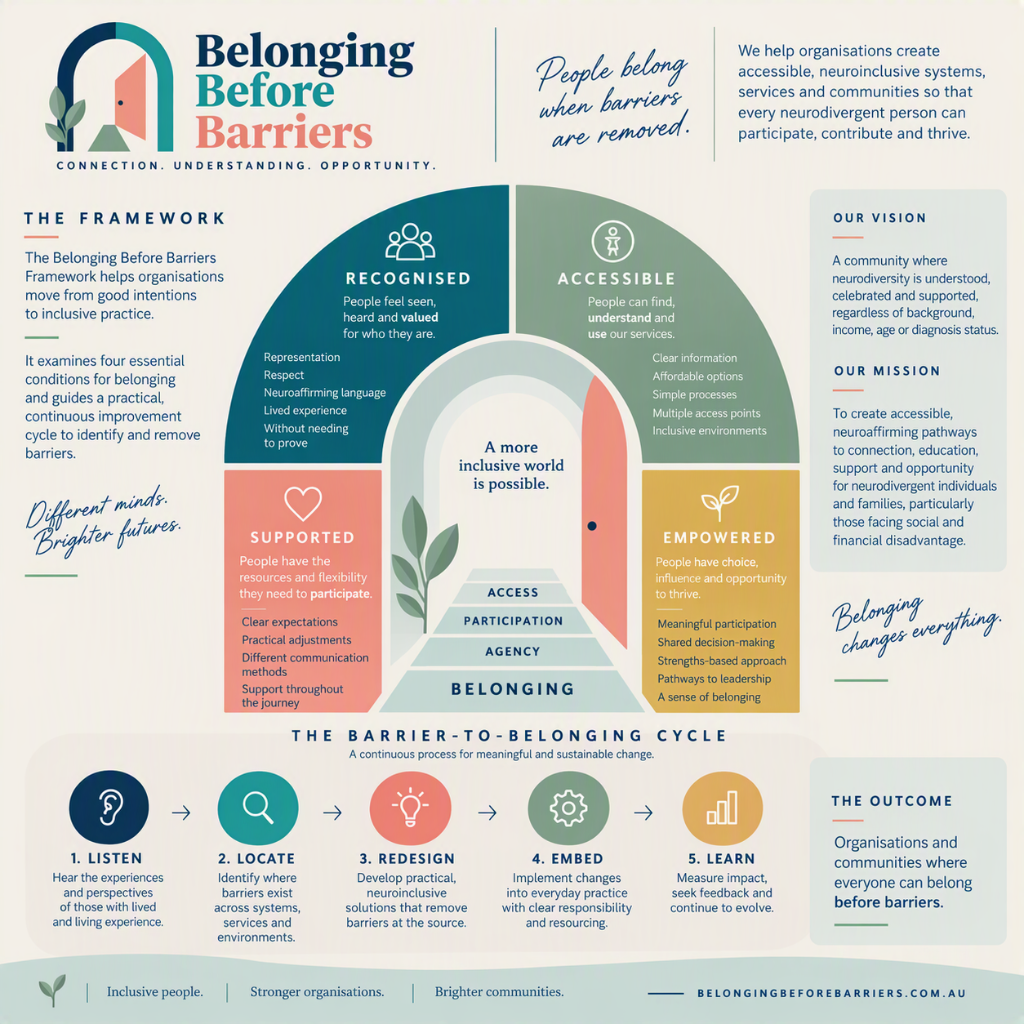
BBB’s framework examines four conditions for belonging and uses a continuous improvement process to connect evidence, priorities, implementation and learning.
People should not have to work around inaccessible systems in order to participate.
The Belonging before Barriers Approach
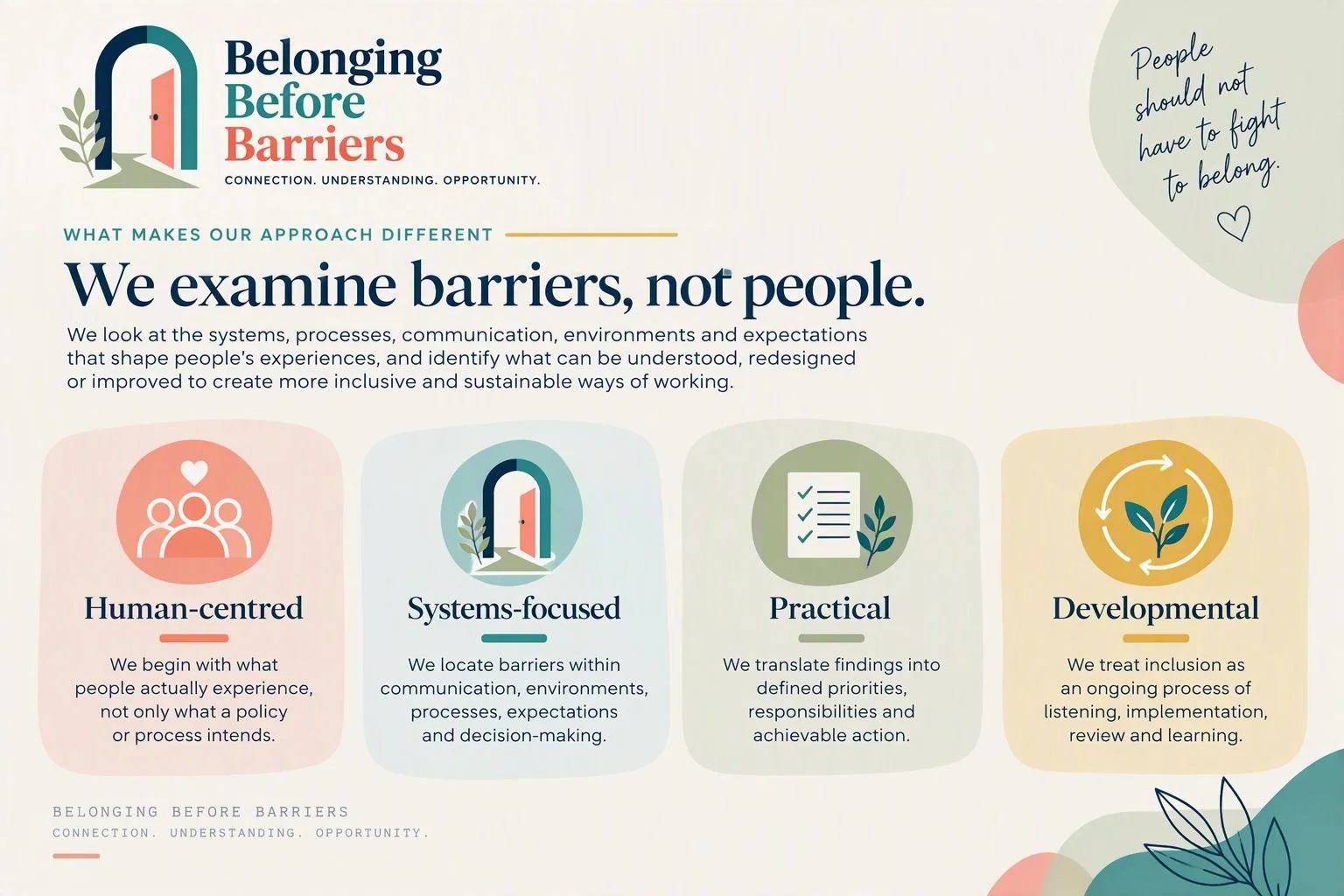
We examine barriers, not people
People are often expected to navigate systems that rely on unwritten rules, narrow communication expectations, complicated processes or inflexible ways of participating.
When someone struggles within those conditions, the difficulty may be attributed to the individual. They may be seen as unprepared, disengaged, resistant or difficult, even when the surrounding system has not provided the clarity, flexibility or access required for participation.
BBB starts from a different position.
We examine the systems, processes, communication, environments and expectations surrounding people. We ask what the organisation can understand, redesign, resource or improve rather than treating difference as a problem to correct.
This does not mean ignoring individual experiences or needs. It means recognising those experiences as valuable evidence about how the surrounding system is working.
What needs to be true for belonging to become possible?
BBB examines organisational practice through four interconnected conditions: Recognised, Accessible, Supported and Empowered.
These conditions help an organisation look beyond whether an opportunity technically exists and consider whether people can understand it, enter it, participate sustainably and influence their experience.

Recognised
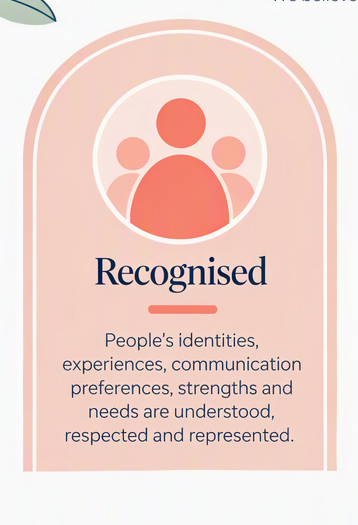
People’s identities, experiences, communication preferences, strengths and needs are understood, respected and represented.
What this can look like
Neurodiversity is recognised as part of human diversity
Respectful, neuroaffirming language is used
Different communication and processing styles are not treated as deficiencies
People with lived experience are visible in organisational thinking
Strengths and perspectives are recognised alongside access needs
Accessible
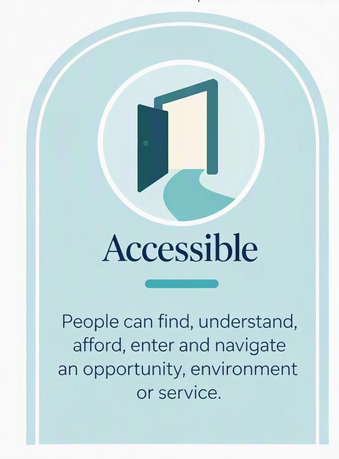
People can find, understand, afford, enter and navigate an opportunity, environment or service.
What this can look like
Essential information is clear and easy to find
Costs, stages and expectations are transparent
More than one practical communication route is available
Information is provided before people are expected to decide or respond
Forms, environments and service pathways reduce unnecessary complexity
Supported
People receive the clarity, flexibility, resources, relationships and adjustments required to participate sustainably.
What this can look like
Instructions and expectations are clear
People can ask questions without judgement
Examples, reminders or written follow-up are available
Processing time and flexibility are built into ordinary practice
Staff have the guidance, time and resources to respond consistently
Empowered
People have meaningful choice, influence, dignity, agency and opportunities to contribute to decisions. [
What this can look like
People can choose how they receive and contribute information
Participation does not depend on rapid verbal responses
People can review and correct how their preferences are recorded
Feedback influences decisions
Lived-experience participation is meaningful rather than symbolic
The four conditions are connected.
A person may be welcomed but still lack understandable information. A service may be technically accessible but provide insufficient support for sustainable participation. An organisation may listen to people without giving them meaningful influence.
BBB therefore examines the conditions together rather than treating any one condition as proof of inclusion.
Belonging is shaped across the whole organisation
The Belonging Before Barriers diagnostic architecture applies the four conditions across six areas of organisational practice. This creates a 24-cell framework that compares organisational intent, observed practice and lived experience.
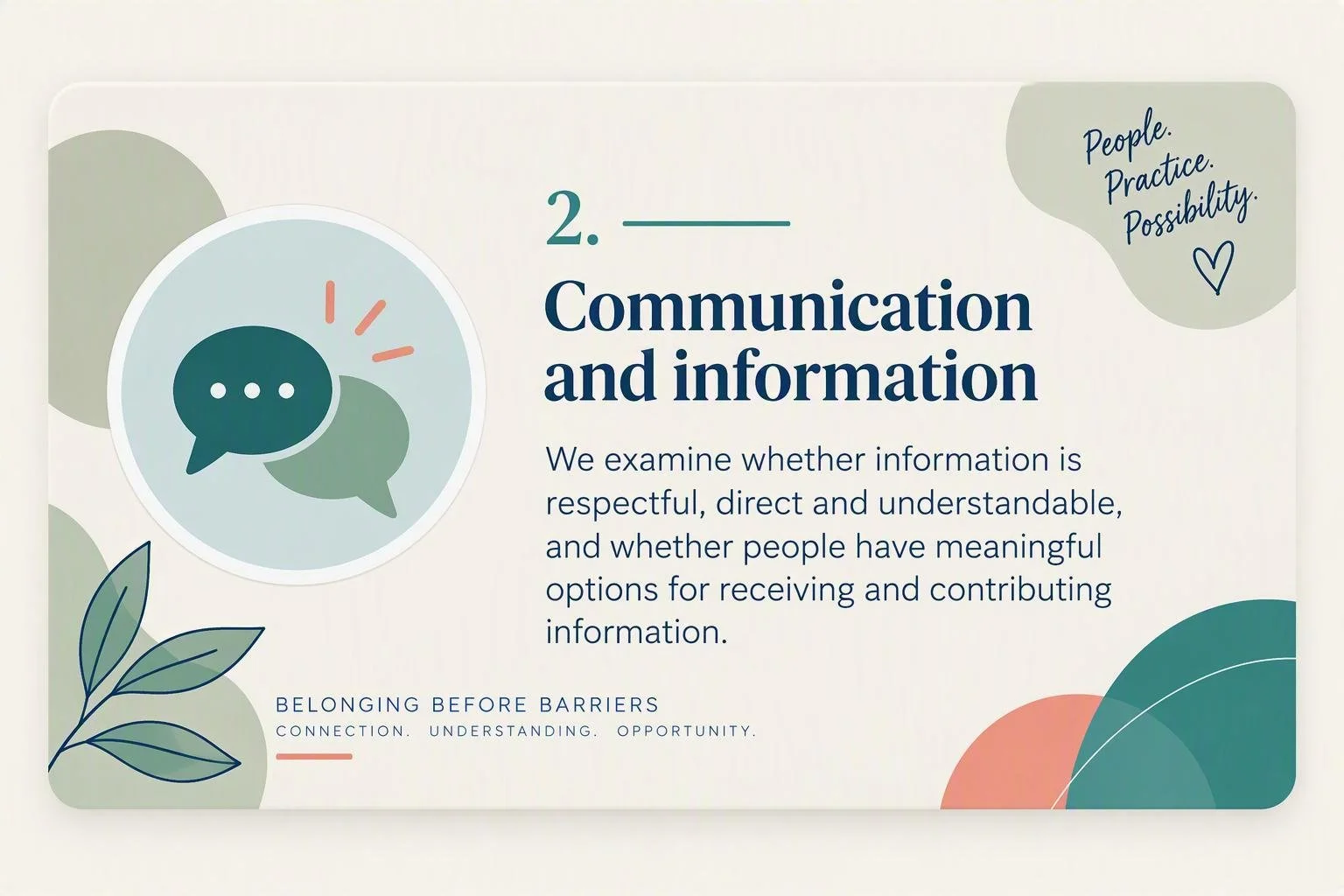
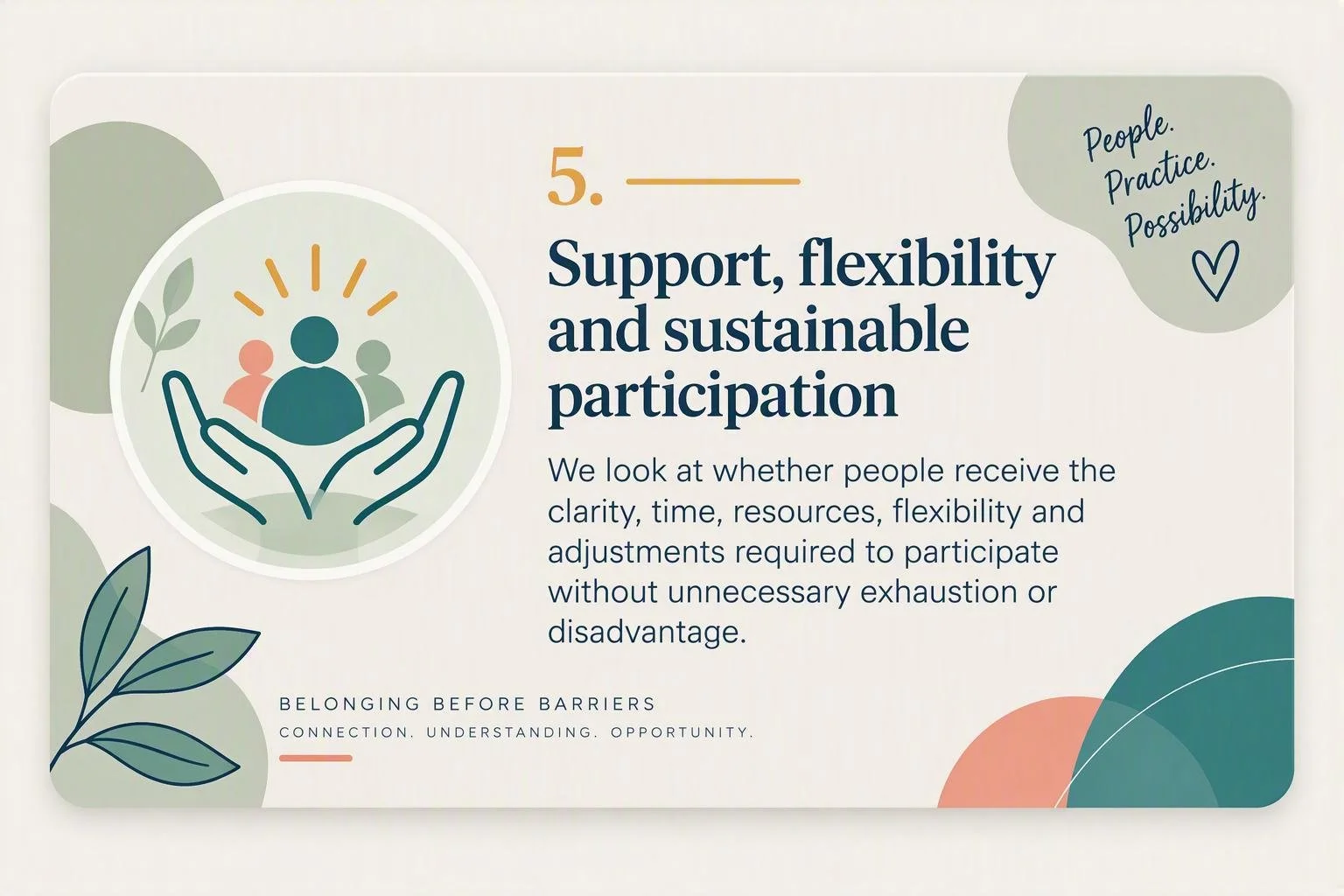
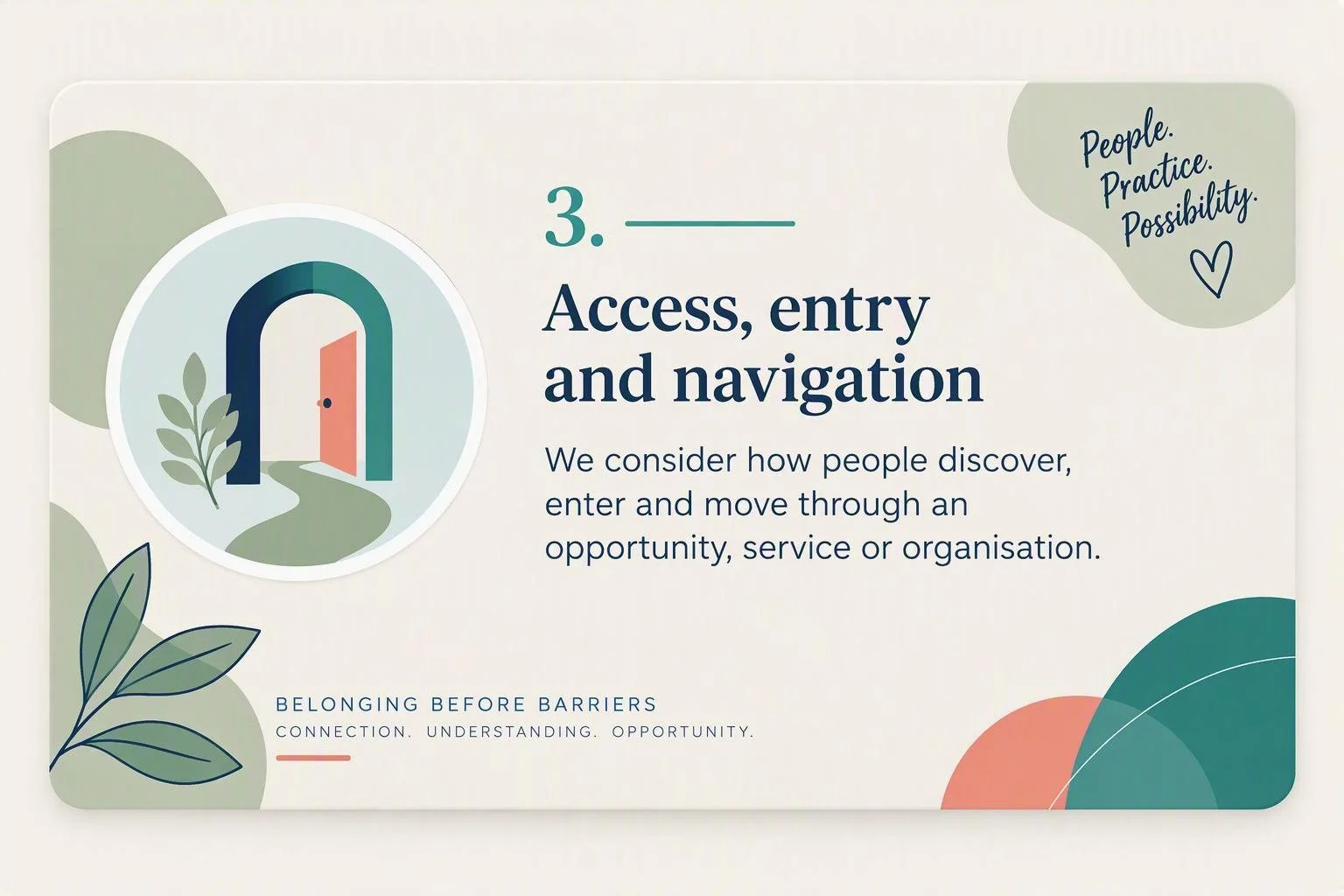
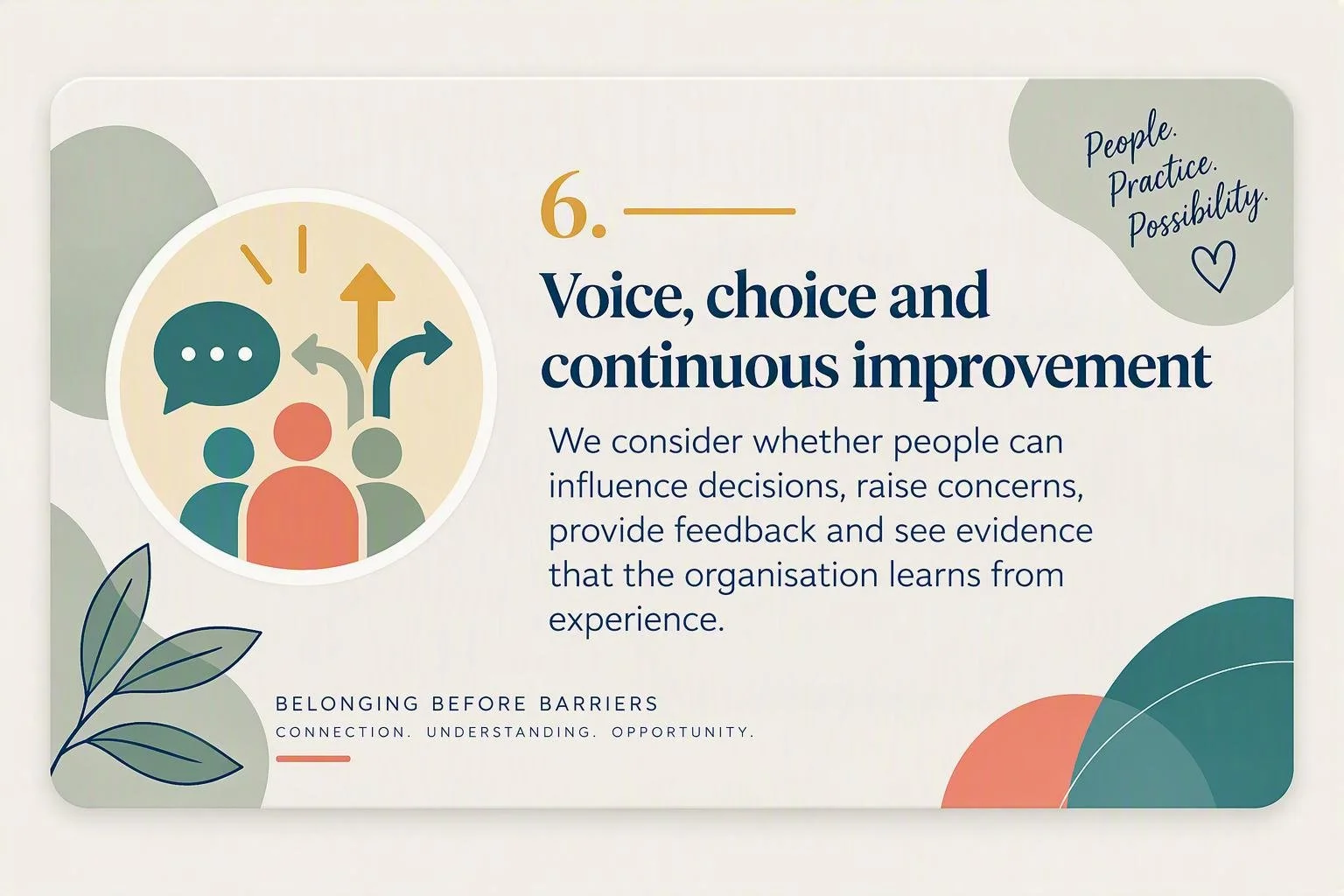
The Barrier-to-Belonging Cycle
Listen. Locate. Redesign. Embed. Learn.
Identifying a barrier is only the beginning.
The Barrier-to-Belonging Cycle provides a practical pathway from understanding an experience to implementing and reviewing organisational change.
1. Listen
Understand what people experience
We confirm what is happening, who may be affected and whose perspective may be missing.
Listening can include lived-experience contributions, organisational information, observed practice and existing service evidence. It should not require people to repeatedly justify their needs or disclose more personal information than the process requires.
2. Locate
Find where the barrier sits
We connect the experience to the relevant system, process, environment, expectation or journey point.
This prevents the barrier from being written as a flaw in the individual. It also helps distinguish an isolated difficulty from a recurring organisational condition.
3. Redesign
Develop change with affected people
We identify and test practical changes with the people affected wherever safe and appropriate.
This stage considers the intended experience, available evidence, organisational constraints and what a realistic first improvement should involve.
4. Embed
Make the change part of ordinary practice
A change is unlikely to last if it depends on one informed or committed person.
We consider how the improvement will be integrated into roles, workflows, resources, communication, responsibilities and governance.
5. Learn
Review what changed and what people experienced
We examine whether the change was implemented and whether people experienced improved access, participation, agency or belonging.
Feedback and evidence then inform adaptation, closure or the next improvement cycle.
Critical BBB principle
An action is not complete simply because a document was written or training occurred. The organisation should be able to show that practice changed and that people experienced a meaningful improvement.
From priority to practical change
Insight must lead somewhere
Once a priority barrier has been agreed, BBB helps translate it into a defined program of change.
The action-planning process can clarify:
The experience that should be different
The system condition that needs to change
The people affected
The actions required
Who owns each action
What resources and authority are needed
How people will influence the redesign
What may support or obstruct implementation
How progress and outcomes will be measured
When the work will be reviewed
BBB’s action-plan methodology links the agreed barrier to owners, resources, participation, milestones and measures. It uses a practical 90-day roadmap and retains the connection between the original evidence, the prioritised barrier and the review decision.
We focus on changed experience, not completed activity
Delivering training, publishing a policy or redesigning a form may be useful actions, but they are not automatically evidence of improved inclusion.
BBB asks what people should be able to access, do, influence or experience differently because of the change.
Participation should involve influence
How BBB works with lived experience
Lived experience should not be added at the end of a process simply to confirm a decision that has already been made.
Where people contribute their experience, BBB aims to make the purpose of participation, level of influence, access arrangements, confidentiality, attribution and feedback process clear.
People should be able to understand:
Why they are being invited to contribute
What decisions they can influence
How they can participate
How their information will be used
Whether quotations or attribution are proposed
How disagreement will be recorded
What happens after they provide input
How they can withdraw where applicable
People are not evidence sources to be extracted from. Participation should be clear, accessible, respectful and connected to visible decision-making.
Our working principles
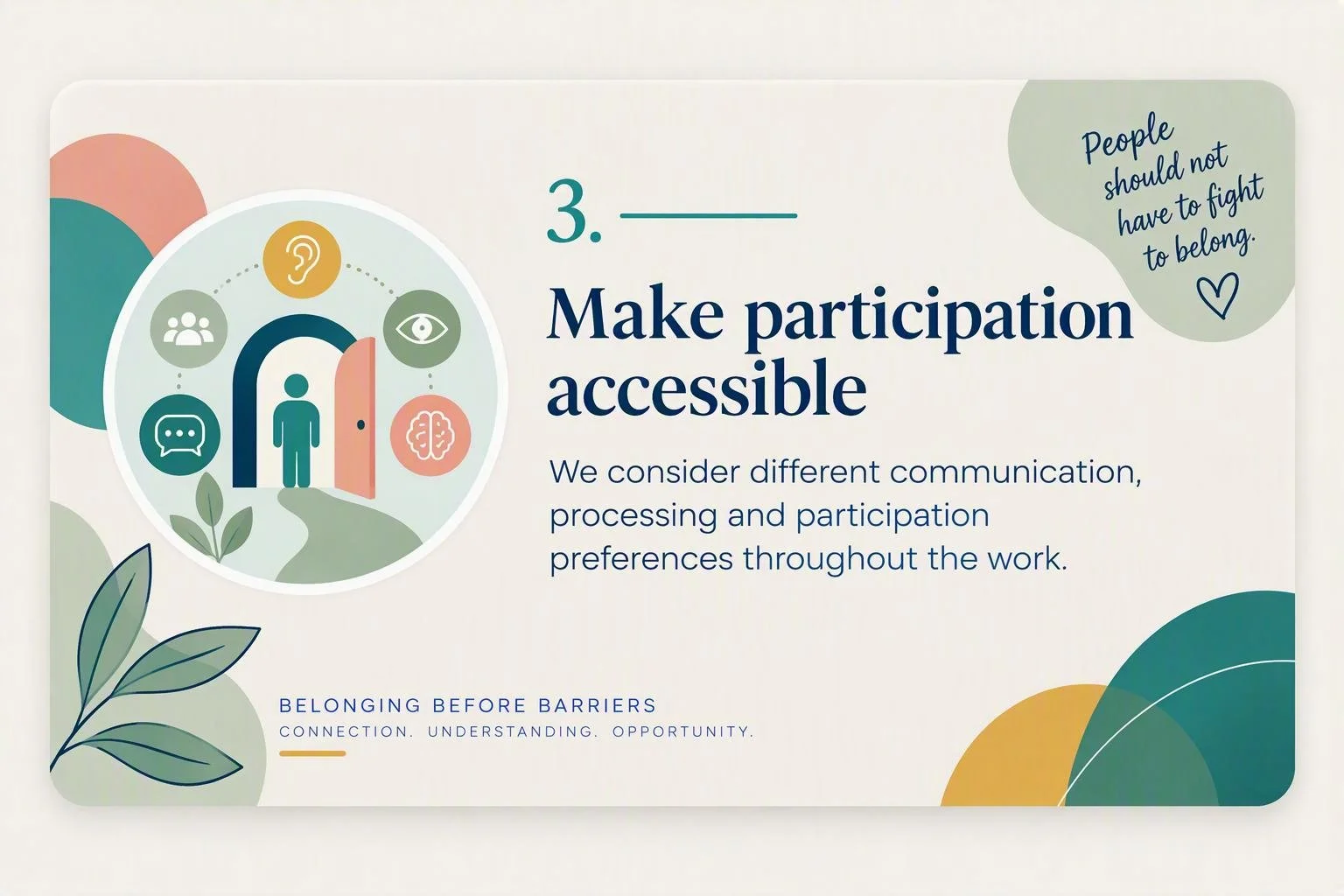
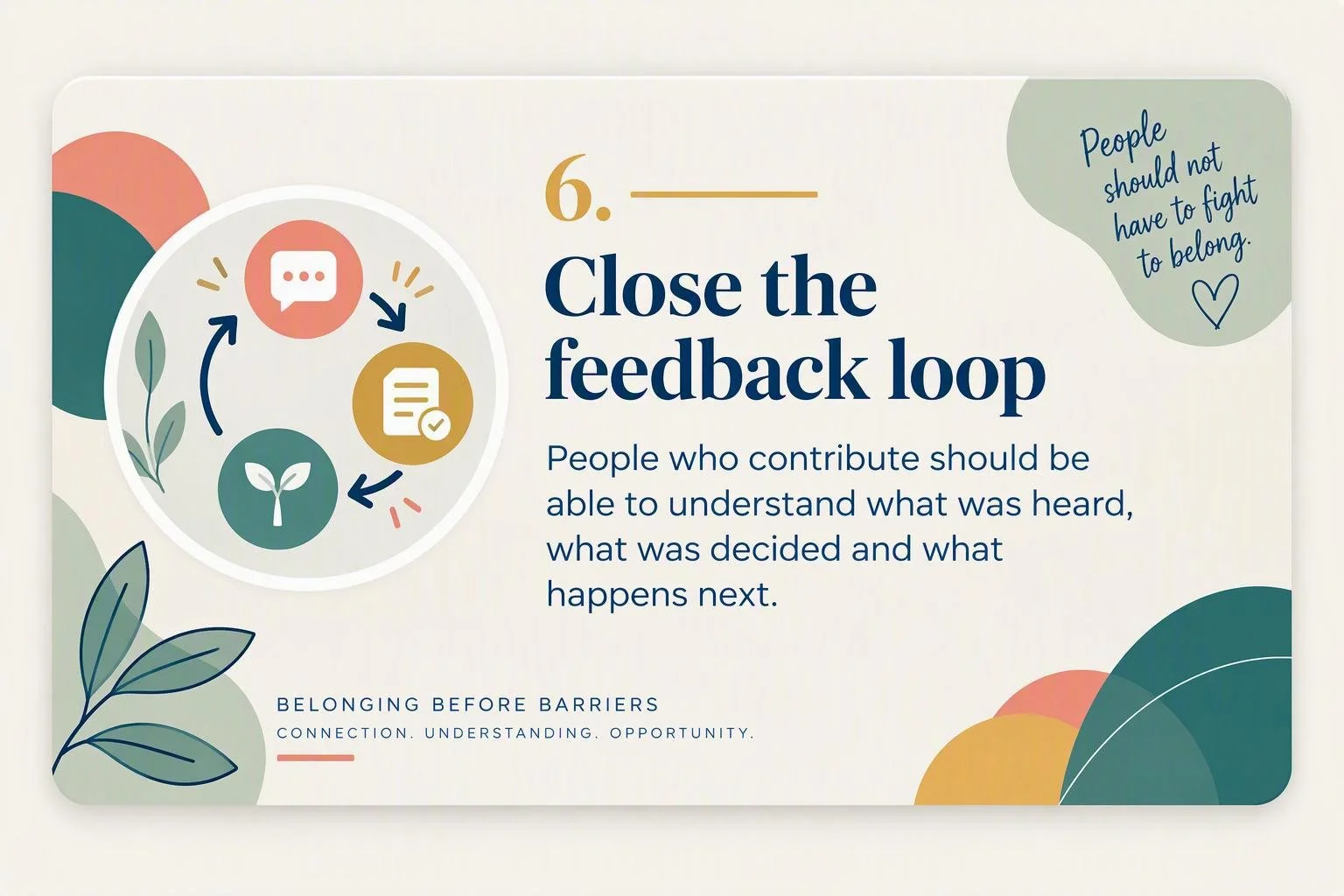
What guides the way we work
What the approach is not
Clear about our role
The BBB approach provides organisational development, neuroinclusion education and service-design support.
It is not:
A psychological or clinical assessment
A diagnostic instrument
Therapy or individual clinical support
A legal compliance audit
Formal accessibility certification
A substitute for emergency, safeguarding or mandatory-reporting processes
BBB’s own framework materials define the method as an organisational development and service-design approach rather than a clinical instrument, legal audit or certification process. Urgent safety, safeguarding, rights or mandatory-reporting concerns should not wait for routine improvement planning.
Where specialist legal, clinical, technical, financial, safeguarding or regulatory advice is required, an organisation should engage appropriately qualified professionals.
Start with the experience you want to change
You do not need to understand the full framework before contacting BBB.
Tell us about the service, process or organisational challenge you are examining, what people currently experience and what you hope could be different.
We can help clarify the issue, determine the most useful starting point and identify whether BBB is the right fit.